The prisoner–SS football match
The Tattooist of AuschwitzThe prisoner–SS football match at Birkenau stands as one of the most surreal episodes in Lale Sokolov's account of survival in Auschwitz. It is a moment where the brutal machinery of the camp briefly pauses to make room for sport, yet the game is never merely a game. Ordered by Stefan Baretski, the SS man who had installed Lale as the Tätowierer, the match becomes a high-stakes performance in which the prisoners must navigate the impossible tension between the desire for a fleeting triumph and the mortal danger of humiliating their captors. The event reveals the strange, contingent spaces of agency that could open even inside the death camp, and the razor-thin line between a moment of glory and a massacre.
The Bizarre Request
The match begins not with a whistle but with a demand. In the aftermath of a morning when Lale, distraught over a dead flower he had hoped to give to Gita, tries to discard it, Baretski follows him and corners him. The SS man, who had earlier shown Lale to a single room inside a newly completed block and granted him extra rations in his role as Tätowierer, now makes an extraordinary request: Lale is to find eleven prisoners to take on a team of SS in a friendly match. The request is so absurd that Lale considers laughing, but he keeps his gaze fixed on a point over Baretski's shoulder, thinking long and hard about his reply. When he asks, "What, no substitutes?" and is told there are none, he answers, "Sure, why not," surprising even himself. Baretski, laughing loudly, tells him to get his team together and meet in the compound in two days' time, on Sunday, adding that they will bring the ball and that Lale can have the day off since there are no transports.
Assembling the Team
Lale's task of recruiting a team meets with resistance. When he puts the question to the gathered men, one voice flatly refuses: "Well, I'm not gonna do it. You can't make me." But from the back of the group, a small man pushes through and steps forward, announcing, "I'm Joel," and offering to play, having played a little before. Lale welcomes him to the team and appeals to the others with a darkly persuasive pitch: "What have you got to lose? This is your one chance to get a little physical with the bastards and get away with it." The recruitment gains momentum when another prisoner mentions knowing a man in Block 15 who played on the Hungarian national team. By the day of the game, a large man, Big Joel, reports proudly that he has fourteen players, counting himself and Lale, with a couple in reserve in case some fall over. Lale, however, insists on the SS rule: no substitutes, just one team, choose the fittest. Three hands rise, and those volunteering to take no part walk away, while the remaining men stretch and jump up and down in the manner of a professional warm-up.
The Game Itself
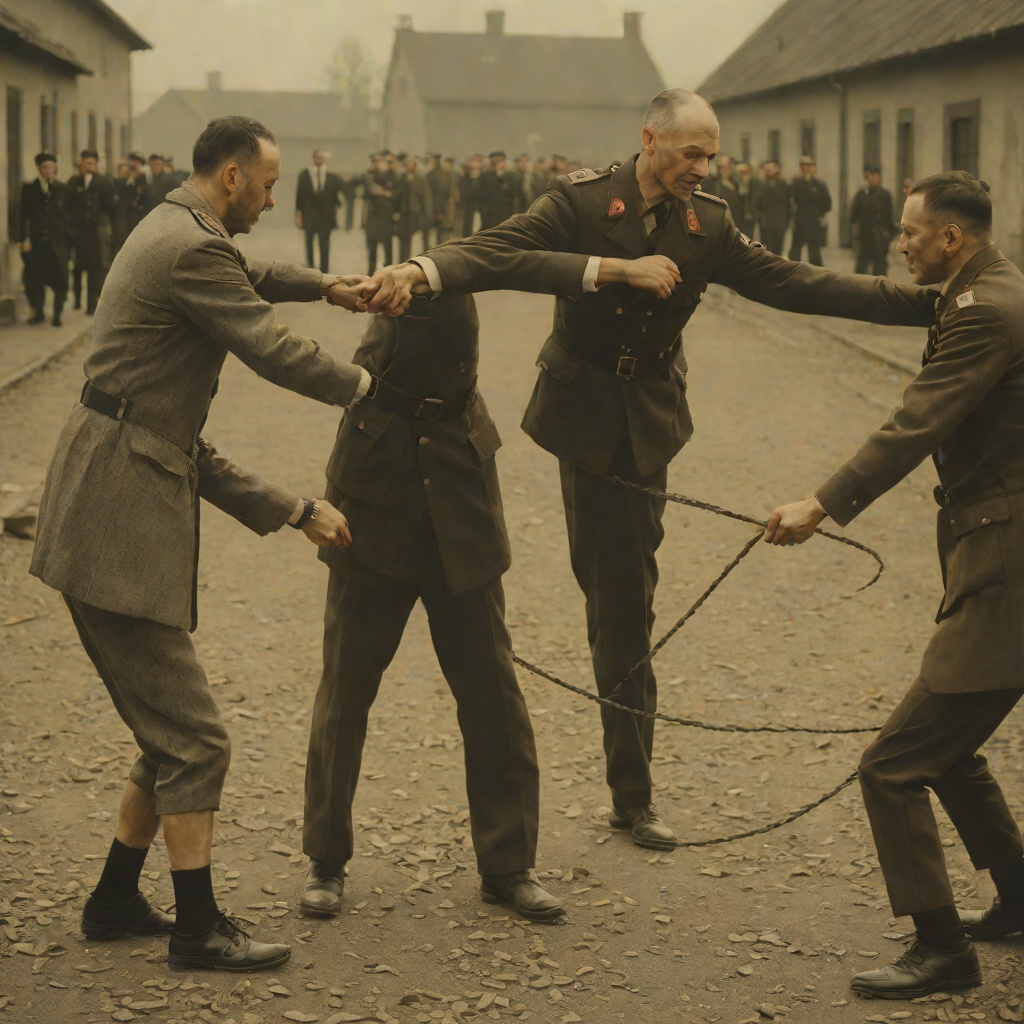
The day of the match arrives with SS officers painting a white line into what is far from an oblong shape. Lale finds his team gathered and joins them. As the game begins, the referee kicks the ball toward the SS team, and it is game on. Ten minutes in, the prisoners have scored two goals to nil. Lale enjoys the goals, but common sense prevails when he looks at the angry faces of the SS. He subtly lets his players know to slow it down for the remainder of the half, and the half ends two all. During the break, while the SS are given drinks, Lale and his team gather to discuss tactics. Lale impresses on them that they cannot win this game. It is agreed that, to help boost morale among the watching prisoners, two more goals can be scored, as long as they lose by one goal in the end. As the second half begins, ash rains down on players and spectators, a grim reminder that the core task of Birkenau has not been interrupted by sports. Another goal goes in for the prisoners, and another for the SS. As their appallingly inadequate diet begins to tell, the prisoners tire, and the SS score two more goals. The prisoners do not need to throw the game; they simply cannot compete any longer. With the SS two up, the referee blows his whistle for full time.
Aftermath and a Private Moment
Schwarzhuber makes his way onto the field and presents the trophy to the SS captain, who raises it aloft to muted cheers from the guards and officers present. As the SS make their way back to their barracks to celebrate, Houstek walks past Lale and offers a single word of acknowledgment: "Well played, Tätowierer." Lale gathers his team and tells them what a great job they have done. The crowd begins to disperse, but Gita has not moved from her spot. Lale jogs over to her, takes her by the hand, and they move through the other prisoners toward the administration block. As Gita drops to the ground behind the building, Lale looks around for prying eyes. Satisfied, he sits beside her and watches as she runs her fingers through the grass, examining it intently. The match, with all its calculated performance and mortal risk, gives way to a quiet, private moment between the two lovers, a fragile respite from the ash and the watching eyes.
The Match's Deeper Significance
The football match is a microcosm of the larger survival strategy that defines Lale's time in the camp. It is a performance of cooperation that conceals a quiet act of resistance, a moment of glory carefully rationed and then surrendered. The prisoners' agreement to score two more goals but lose by one is a precise calculation of how much defiance the SS can tolerate, a negotiation between the desire for dignity and the imperative of survival. The match also reveals the strange intimacy of the camp's power structures: Baretski, who orders the game, is the same man who gave Lale his room and his extra rations, and Houstek's brief praise after the match underscores the ambiguous relationship between the tattooist and his captors. The event lingers in the memory as one of the few moments where the prisoners could look the SS in the eye on something like equal terms, even as the ash of the crematoria rained down on the pitch, a reminder that the game was a brief interlude in a machinery of death that never truly stopped.